
How Much Does It Cost to Hire Staff in the Philippines?
Most full-time staff cost around $500 to $1,500 per month, depending on the role and experience.
With VirtualStaff.ph, you pay $99/month per VirtualStaff Seat + the salary you agree with your staff member.
You choose the person. You agree on the salary.
See Staff Salary Ranges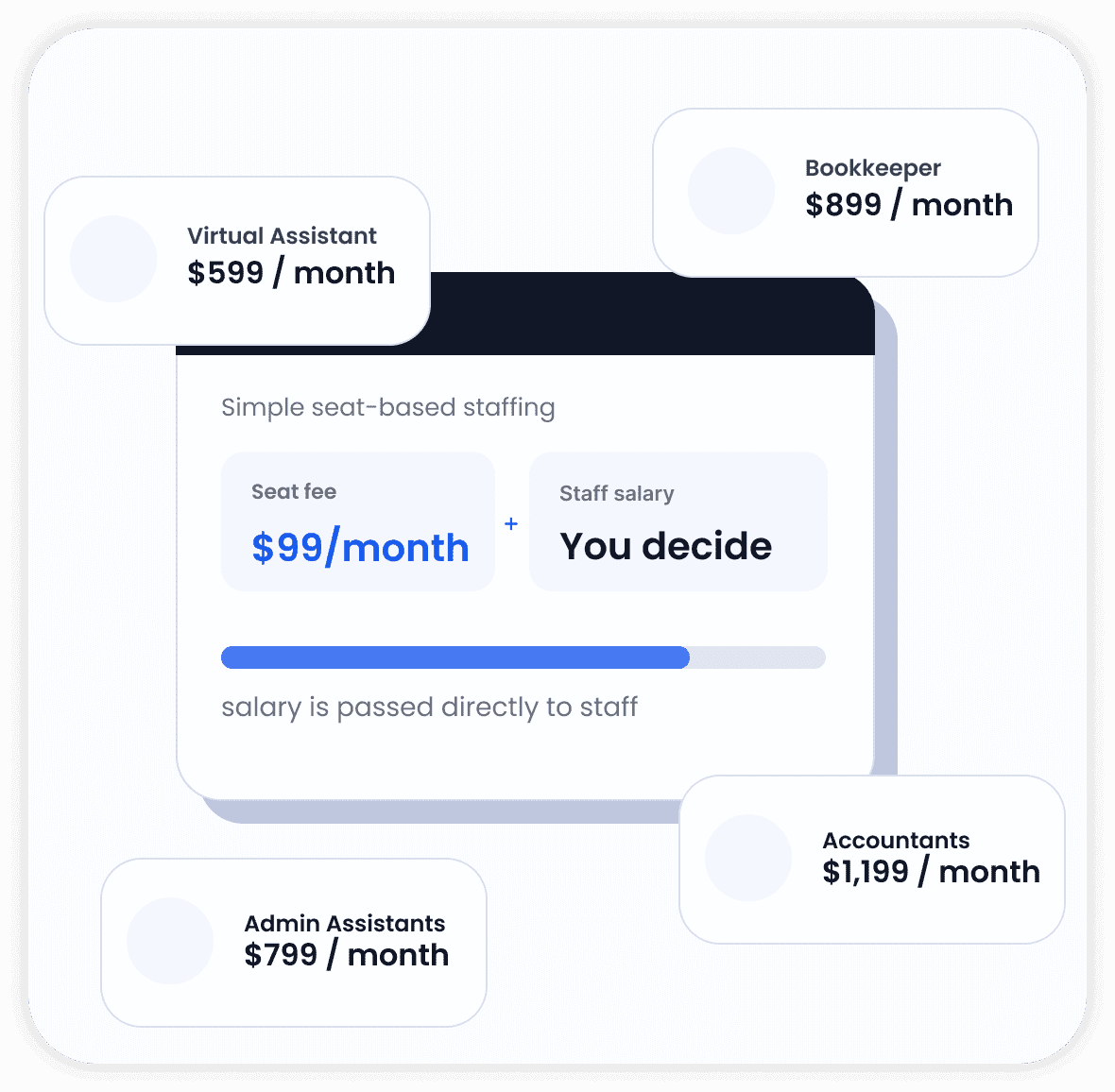
Your Cost Is Simple
When you add a staff member through VirtualStaff.ph, you pay:
$99/month for your VirtualStaff Seat

The salary you agree with your staff member
That's it.
One VirtualStaff Seat supports one staff member.

VirtualStaff.ph earns the $99 monthly Seat fee, while the agreed staff salary is passed directly to your staff member.
This gives you a clearer cost structure and helps you avoid the heavy ongoing salary markups common with many traditional offshore staffing companies.
Typical Monthly Salaries for Philippines-Based Staff
Here is a practical guide to what businesses may pay for common full-time roles.
| Role | Approx. Monthly Salary |
|---|---|
| Accountant / CPA | $800 to $1,800 |
| Admin Assistant | $500 to $800 |
| Billing Specialist | $600 to $1,000 |
| Bookkeeper | $600 to $1,000 |
| Content Writer | $500 to $800 |
| Data Entry / Research Assistant | $400 to $700 |
| Executive Assistant | $700 to $1,100 |
| Graphic Designer | $500 to $900 |
| Healthcare Admin Assistant | $600 to $1,000 |
| Legal Assistant | $600 to $1,000 |
| Logistics Assistant | $500 to $900 |
| Customer Support Representative | $500 to $1,000 |
| Social Media Assistant | $500 to $1,000 |
| Video Editor | $500 to $1,000 |
| Virtual Assistant | $500 to $900 |
| Voice / Phone Support Representative | $500 to $900 |
These are guide ranges, not fixed prices.
The right salary will depend on the role, experience, working hours, specialist knowledge and the person you choose.
You stay in control of what you offer and what you agree.
What Does That Look Like in Real Numbers?
If you agree to pay your staff member:
$800/month
Your total monthly cost would be:
Staff salary
$800/month
VirtualStaff Seat
$99/month
Total
$899/month
If you agree to pay your staff member:
$1,200/month
Your total monthly cost would be:
Staff salary
$1,200/month
VirtualStaff Seat
$99/month
Total
$1,299/month
Simple, transparent and easy to understand.
Why is the cost structure different?
VirtualStaff Seats are a different way to add Philippines-based staff into your business.
Instead of building a large ongoing margin into salary, VirtualStaff.ph uses a simple seat-based model.
You pay $99/month for the VirtualStaff Seat.
You choose the staff member.
You agree on their salary.
The agreed salary is passed directly to them.


That means you retain more control over what you pay while still getting the structure of a staffing platform to help you add, onboard and pay your staff member.
More of your budget goes to the person doing the work
The attraction of adding staff from the Philippines is not simply paying less.
It is being able to add capable people to your business at a cost structure that makes sense.
With VirtualStaff Seats, you know:
What your staff member earns.
What VirtualStaff.ph earns.
What your total monthly cost is.

No complicated pricing structure.
No wondering how much of your monthly staffing bill is actually going to your staff member.

What Kind of Staff Can You Add?
Businesses use VirtualStaff Seats to add professional Philippines-based staff across roles such as:
Virtual Assistants
Admin Assistants
Bookkeepers
Accountants
Billing Staff
Customer Support Staff
Operations Staff
Executive Assistants
Healthcare Admin Staff
Legal Assistants
Logistics Staff
Video Editors
Graphic Designers
Social Media Staff
Back-Office Support Staff


Your staff member plugs into your business operations, systems and processes, while you manage their actual day-to-day work.
You Stay in Control
A smarter cost structure should not mean giving up control.
With VirtualStaff.ph:
You choose the staff member
You receive qualified staff options and decide who fits your business.
You agree on the salary
You and the staff member agree on what they will be paid.
They work inside your business
Your staff member plugs into your existing tools, systems, processes and management structure.
You manage the day-to-day work
They become part of your extended team, while you remain responsible for their actual workday and performance.
VirtualStaff.ph handles the staffing platform
Your VirtualStaff Seat gives you the system to help add, onboard and pay your staff member.





One VirtualStaff Seat. One Staff Member
The model is designed to stay simple as your business grows.

Start with one Seat
Add the first staff member your business needs.

Add more Seats as you grow

Need another admin assistant?
Add another Seat.
Need a bookkeeper?
Add another Seat.
Need customer support?
Add another Seat.



One VirtualStaff Seat supports one staff member.
Build your team one Seat at a time.
A Better Way to Add Offshore Staff
Most businesses looking at the Philippines want the same basic outcome:
Good people. More capacity. A cost structure that makes sense.
VirtualStaff Seats are built around that.
You get the control of choosing your own staff member and agreeing on the salary, with the structure of a staffing platform around the process.
That is the key difference.
VirtualStaff.ph should feel like a better way to add staff into your business, not simply another place to find people.

Frequently Asked Questions
Ready to Add Your Next Staff Member?
Professional Philippines-based staff
A salary you control
A simple $99/month VirtualStaff Seat
Start with one Seat and add more as your business grows.
$99/month per VirtualStaff Seat + agreed staff salary